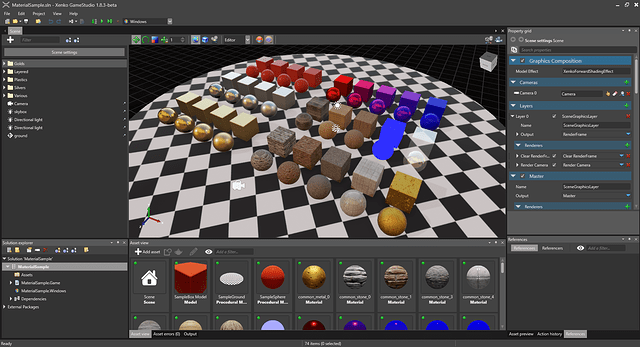
I’ve been looking around for a physics-based rendering system and came across Xenko as an engine. I was wondering if there has been any stress-tests as to what the maximum performance and quality can be achieved, or if anyone has some experience with regards to Xenko’s performance at all.
Sadly I don’t know. The description doesn’t mention anything. I view PBR as a default these days. So, if the video’s description isn’t mentioning any mobile device, or isn’t stating that it’s not PBR, then it is PBR.
Xenko is also being advertised as an PBR engine. However, seems it’s best that Silicon Studio commented on this.
Xenko is advertised as a pbr engine indeed, but I don’t know its history. If it ever used to be non-pbr, then this video could be from that time. The quality difference between current games and the video isn’t exactly visible, which makes me think it’s using regular phong.
With regards to PBR being the standard, unfortunately this isn’t exactly the case yet. Take a look at Unity for example. It’s one of the leading engines in the industry, yet it has no integrated possibility for PBR as far as I know.
Xenko supports PBR.
There was a material sample in previous versions (until 1.8.3) that has been removed in 1.9. You can still create it with the 1.8.3 version (and eventually upgrade it to a more recent version).
Glad we have that sorted out then
The question with regards to performance remains though, but I presume nobody has performed a stress-test on the PBR part of the engine yet. Would be useful information to have
I’m not sure what you mean. Since Unity 5, all default shaders are PBR. However, the actual implementation of PBR may be a bit different witch each engine. Maybe that’s what you mean.
Apparently I’ve just been out of the scene for a while… I wasn’t aware of Unity 5 even being released. I suppose it is safe to assume pbr being the standard nowadays in that case then, given that 2 of the leading engines have switched over and it clearly being better visual-wise.
Stingray seems to support PBR (simple google search showed the possibility to create a PBR shader integrated in the engine). As far as I know, Xenko is the only open-source one of those 4 though?
When I was investigating Xenko for my game I set up identical scenes in Unity and Xenko. This scene contained 100 instances (clones) of one of my spaceships, which has two PBR materials on it.
I didn’t record any solid data, and this was before the multi-threading performance improvements introduced in 1.8, but at that time Xenko trailed behind Unity but only by a few FPS. Both were using DirectX 11.
Rendering quality was very similar between them, but I found Xenko’s shadows to be much better than Unity’s.
This is however anecdotal, I would love to see someone put together a comprehensive comparison (right now I really don’t have the time).
Thanks for the info Although actual metrics would be better indeed, I’m glad you made the check and posted your findings. Given that Xenko is open-source whereas Unity is not, and their performance used to be similar prior to an update on Xenko my preference would be going to it rather than Unity. Thank you.
At this moment in time Xenko doesn’t offer the ease of access that Unity does, especially since it doesn’t have an asset store (at least not yet).
However there is no doubt in my mind that Xenko is a superior engine. The quality of it’s architecture and API is world class, I really enjoy working with it.
I have also found Xenko to be much more stable than Unity. My game some crash to desktop bugs in Unity, which I was unable to debug as they occurred in the core (C++) engine, but the same code ported to Xenko (with some relatively minor API changes) has not crashed once. Most of these crashes were related to the modding system, where I was dynamically loading assets (textures, models etc.) at run time.
Don’t forget the editor. Unity Editor is 12 years old, and still so damn basic and unpolished. Xenko isn’t out yet, but gives me the feeling that it can do already more than Unity Editor. Not even UE4 editor got full DPI scaling for 2160p monitors. Xenko’s Game Studio isn’t blurring out the font on monitors that are higher than 1080p resolution.
 but this doesn’t look like it’s been drawn using physically-based rendering? Or am I just looking at it wrong?